Introduction
Working non-traditional hours is increasingly common—especially for remote shift-workers. Whether you’re on overnight support, international time-zones, or rotating schedules, your sleep schedule is under assault. Studies show that shift work disrupts the body’s internal clock (circadian rhythm), reduces sleep quality, and increases risks for metabolic and cardiovascular issues. PubMed+2PMC+2
But the good news? With a carefully designed 7-day reset plan, you can restore better sleep, improve alertness and performance, and protect your long-term health.
Here’s a science-backed plan tailored for remote shift-workers—complete with daily steps, environmental tweaks, and lifestyle hacks.
Why Remote Shift Work Makes Sleep Hard
Understanding the “why” helps you stick to the “how.”
Circadian disruption & misalignment
Your body is wired to sleep at night and wake during the day. When you work odd hours, your internal clock gets misaligned. Studies show this misalignment correlates with worse sleep, poor metabolic control, cognitive impairment and even greater health risks. PMC+1
Sleep quality & duration suffer
Shift‐workers commonly report shorter sleep, fragmented sleep and poorer recovery. One review found that rotating or night shifts significantly increase risk of insomnia or sleep disturbance. PMC+1
Health implications
Beyond tiredness, chronic mis-aligned sleep may raise your long-term risk for metabolic syndrome, cardiovascular disease, mood disorders and more. PMC+1
Given all that, a dedicated reset plan is wise—especially if you’re remote and managing your own schedule.
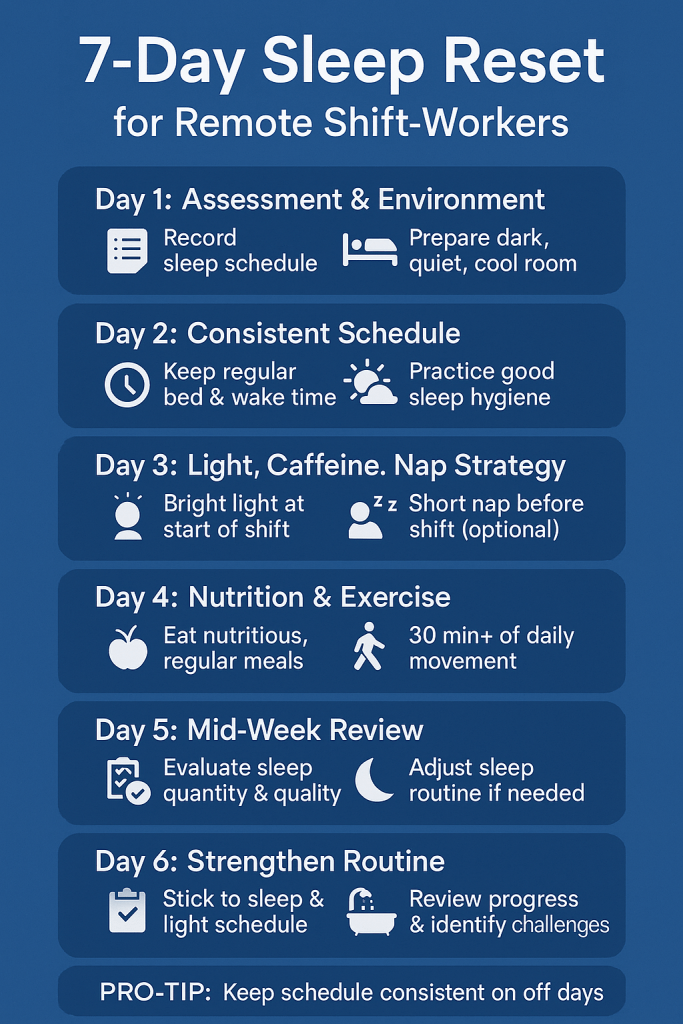
7-Day Sleep Reset Plan Overview
The goal of this week: establish rhythm, optimize environment, adjust behaviours, and build habits that support high-quality sleep even with odd hours.
Day 1 – Assessment & Environment Setup
Morning/Afternoon (day after your shift or on your off-day):
- Record your current sleep schedule: when you woke, how long you slept, how rested you feel.
- Create your ideal sleep window (target ~7-9 hours total sleep in a 24-hour cycle). Sleep Health Foundation
- Prepare your sleep environment: blackout curtains, ear-plugs, white noise machine, cool temperature (~65–68°F / ~18–20°C).
- Remove electronic screens at least 30 min prior to bed, or use blue-light filters.
Evening:
- Wind-down routine: take a warm shower or bath, do light stretching or meditation, dim the lights. This helps signal your body that sleep is coming. Sleep Foundation
- Set up light exposure plan: On your upcoming shift nights, plan bright light exposure during work hours, and low-light transition before sleeping. Light is a strong cue for circadian rhythms. OUP Academic
Day 2 – Consistent Schedule & Sleep Hygiene
- Aim to go to your designated sleep time and wake time consistently—even on your off day. Consistency helps your body adapt. PMC
- Follow sleep hygiene: avoid heavy meals and caffeine too close to your sleep window, avoid alcohol as it fragments sleep. PMC+1
- Before bed: wind down with reading or light non-stimulating activity, use your bed for sleep only (not for work or heavy screen time).
Day 3 – Light, Nap & Caffeine Strategy
- Light: On your shift, expose yourself to bright (cool) light at the beginning of your work period; after work, wear sunglasses exiting bright daylight to reduce alerting effect.
- Nap: If transition is long, consider a short nap (20-30 mins) before the shift starts—this can reduce sleepiness without interfering with your main sleep.
- Caffeine: Use strategically early in shift; avoid caffeine within ~4 hours of your planned sleep time. UCLA Health
Day 4 – Nutrition, Movement & Body Clock
- Eat regular nutritious meals timed to your schedule; avoid heavy meals right before sleep.
- Schedule light physical activity: ideally 30 mins of moderate movement during your wake period (not right before bed). Some research shows timed exercise can help circadian adaptation. Nature
- Review your environment: Is your bedroom dark enough? Are there distractions? Sound? Light leaks? Block or mitigate them now.
Day 5 – Mid-Week Review & Adjustment
- Review your sleep diary so far: how many hours slept, how rested you woke.
- If you’re having difficulty: revise your wind-down routine, consider adding relaxation or breathing exercises.
- Use your sleep window strictly—avoid staying up later “just this once.” Staying consistent reinforces the rhythm.
- Start blocking off non-essential tasks during your sleep window (e.g., schedule house chores, social media outside your core sleep time).
Day 6 – Strengthening the Rhythm
- Continue your schedule with minimal variation even on “off” days if possible. Studies show that returning to a normal daytime schedule on off days hinders circadian adaptation. PMC
- Add a pre-sleep ritual: light stretching or yoga, journaling or a short guided meditation to mark the transition from wake to sleep.
- Continue managing light: after your shift ends, reduce light exposure and noise—help your body transition into sleep mode.
Day 7 – Reflection & Plan Forward
- Evaluate your week: total sleep hours, sleep quality, mood, alertness during your shift.
- Identify what worked (e.g., blackout curtains, consistent schedule) and what needs improvement (e.g., caffeine timing, nap length).
- Create a sustainable plan for the coming weeks: keep your sleep window, light strategy, nap/caffeine plan, and environment optimized.
- Preview how you’ll handle schedule shifts ahead (rotating shifts, days off) using the same principles.
Key Tips & Science Highlights
- Target 7-9 hours of sleep within 24 hours, even if broken into segments. Sleep Health Foundation
- Consistency matters: The more irregular your schedule, the more misaligned your circadian rhythm. PubMed+1
- Bright light + darkness cues: Exposure to bright light at the right time helps shift your rhythm; darkness (or sunglasses/light control) when you’re off-duty helps. OUP Academic+1
- Pre-bed routine & environment: Relaxation, dim light, cool room, and limiting stimulating screens or food all help improve sleep onset and quality. Sleep Foundation+1
- Caffeine & naps: Use them strategically; avoid too close to sleep time, and use naps to supplement but not replace your core sleep.
- Lifestyle & schedule planning: Nutrition, movement, and handling days off or schedule changes intelligently support recovery.
FAQs
Q: Can I split my sleep into two shorter naps instead of one long block?
Yes. For remote shift-workers, splitting sleep may sometimes fit better with your schedule (for example, a nap before shift plus a longer sleep after). It’s important to get the total 7-9 hours and maintain consistency. Some studies show that planned naps help reduce fatigue. Sleep Foundation+1
Q: What about days off—should I switch back to “normal” daytime sleep?
Ideally, no. Switching back to a day-sleep schedule on off days prevents your body from adapting and can prolong circadian misalignment. Maintain your schedule as close as possible even on nights off. PMC+1
Q: How much caffeine is safe and when should I stop drinking it?
Use caffeine at the start of your shift or when you need alertness, but avoid caffeine within around 4 hours of your planned sleep time. This helps avoid sleep latency and fragmented rest. UCLA Health
Q: What if I still can’t sleep well after this week?
If you continue to struggle with sleep (difficulty falling asleep, staying asleep, excessive sleepiness or mood changes), you may have Shift Work Sleep Disorder (SWSD). That affects 10-40% of shift workers. Cleveland Clinic+1 Consider consulting a sleep specialist.
Q: Are there any supplements or medications I should use?
Supplements (e.g., melatonin) can help some shift-workers, but they should be used under medical advice. The primary focus should be on light management, sleep scheduling, hygiene and behaviour. Sleep Foundation
Conclusion
If you’re a remote shift-worker, your sleep schedule doesn’t have to mean chronic fatigue, foggy performance or declining health. By following this 7-day reset plan—anchored in consistency, environment optimization, light/caffeine/nap strategies—you’ll be building a foundation for better sleep, improved alertness and long-term resilience.
Use the environment tweaks (blackout curtains, cool room, wind-down routine), the behavioural tactics (scheduled naps, strategic caffeine, timed light exposure) and the planning tools (sleep diary, consistent schedule, internal link resources) to turn your challenging schedule into a sustainable rhythm.
Sleep may be your secret weapon for productivity, health and life-balance—even when everyone else is asleep but you.
Here’s to your next shift being the best one yet—because you slept well.
 Remote Shift Wellness